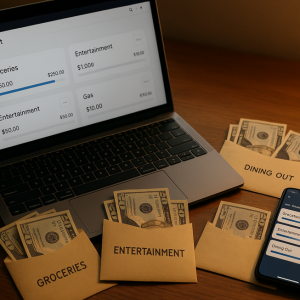
The Envelope Method: Does It Still Work in the Digital Era? ✉️💡
In an age where our phones pay the bills and cryptocurrencies challenge the notion of cash, stashing physical money into envelopes might seem as archaic as penning a letter with ink and quill. Yet, the envelope method, a budgeting technique that could be as old as the idea of money itself, is not only surviving but witnessing a peculiar revival. Is it pure nostalgia, or does this tangible tool still hold its ground amidst the digital tides? 💸📱
At its heart, the envelope method is disarmingly simple: divvy up physical cash to cover different expense categories (like food, fun, and transportation) and tuck each sum into its designated envelope. Once an envelope is empty, further spending in that category must pause until the next financial cycle. This approach, both archaic and refreshing, holds a magnetic pull that’s proving hard to resist, even in a world that seemingly holds no place for coins and paper.
Roots and the Psychology of Cash
The concept of assigning pieces of one’s wealth to certain purposes is arguably as old as the notion of budgeting itself. The modern form of the envelope method took hold during the 20th century, capitalizing on its innate ability to curtail discretionary spending. Behavioral economics sheds light on its effectiveness through the concept of «pain of paying.» Using physical cash invokes a greater psychological discomfort than the mere swipe of a card or a click on «purchase now.» Seeing the stack of banknotes dwindle stimulates a keen awareness of limits that a dwindling number in a digital account might not.
Moreover, the envelope method fosters a proactive financial lens. It necessitates reflection, evaluation of income streams, delineation of expense categories, and the setting of concrete spending limits. Such mindful budgeting is, in itself, an essential stride towards enhanced financial control.
The Challenges of a Less Tangible World
With the advent of digital finance, strict adherence to the traditional envelope method encounters inevitable hurdles. Cash usage has plummeted in numerous economies, with some vendors even shunning it outright. Automated bills, recurrent subscriptions, and virtual shopping are standard practices, not easily manageable with physical money.
- Automated Payments: Services like utilities and rent are commonly auto-deducted and don’t fit well within a cash-only envelope system.
- Online Shopping: A significant portion of spending for many, necessitating digital transactions.
- Reduced Cash Use: The ubiquity and ease of card and mobile payments make handling and withdrawing substantial amounts of cash impractical and, to some, a security risk.
- Complex Tracking: Efforts to merge cash envelope expenses with digital spending can complicate the overall budgeting image.
Faced with such realities, one might wonder if the envelope method is nothing more than a financial fossil poised for extinction. But is that truly the case? 🧐
Adaptation or Extinction: Reimagining the Envelope
The prevailing answer leans toward adaptation. While an exclusive embrace of tangible envelopes may present challenges, the core tenets—segmentation, visual limits, and intentional spending—remain profoundly relevant. The secret lies in transposing these principles into the digital domain or adopting a hybrid strategy.
1. Virtual Envelopes and Budgeting Apps 📲🔍
Numerous personal finance applications, such as YNAB and Goodbudget, embrace the «virtual envelopes» concept. These facilitate digital earmarking of income for various spending categories. Purchases, whether by card or transfer, are recorded and deducted from their respective digital envelopes. These tools provide:
- Synchronization with bank accounts for streamlined tracking.
- Clear visibility of remaining funds in each category.
- Accessible financial oversight from anywhere.
- Detailed reports on spending trends.
Such digital solutions modernize the method, preserving its essence of allocation and limit but adapting it to the currents of digital money flow.
2. Multi-Account Strategy 🏦
Some individuals replicate the method through multiple bank accounts or sub-accounts (offered by certain digital banks). One can maintain a primary account for income and fixed bills, and then transfer specific sums to other accounts designated for variable expenses like food and leisure. Utilizing separate debit cards for each account can mimic a «digital envelope» system.
3. The Hybrid Approach 💰+💳
The pragmatic solution for many is a combination of both worlds. Utilizing online banking and automatic deductions for fixed and predictable costs (mortgage/rent, utilities, insurance), while applying the physical cash envelope method to discretionary categories prone to overspending, such as:
- Groceries and supermarkets.
- Dining and nightlife.
- Entertainment and leisure.
- Small personal expenses («pocket money»).
This approach leverages the responsible spending incentives of cash where it’s most needed, while retaining digital convenience for more routine transactions.
4. Modern «Cash Stuffing»
The resurgence of the method, often heralded by the viral term «cash stuffing» on social media, underscores its enduring allure, especially among younger generations seeking a tangible anchor amid economic uncertainty. Often employing binders filled with transparent pocket sleeves instead of envelopes, the principle remains unchanged. This rebirth highlights the innate human desire for visual and tactile control in financial management, even as a counterpoint to the digital spectrum.
Is It Still Effective? Updated Pros and Cons
Assessing the method’s (in its pure or adapted forms) relevance today:
Enduring Advantages 👍
- Built-In Discipline: Physical or visual spending limits remain a formidable deterrent against impulsive purchases.
- Expense Awareness: It challenges individuals to confront their actual spending in each category.
- Conceptual Simplicity: Simple to comprehend and implement in its fundamental form.
- Debt Prevention: Spending only what is allocated makes accruing debt difficult (particularly with the pure cash method).
- Psychological Control: Handling cash (or direct digital representations) can provide a heightened sense of financial command.
Modern Disadvantages and Considerations 👎
- Partial Incompatibility: The pure cash method clashes with the prevalence of digital payment infrastructures.
- Security Concerns: Handling large sums of cash poses inherent risks.
- Inconvenience: Requires regular cash withdrawals and can be cumbersome to manage. Digital tracking demands diligence in recording transactions.
- Less Rewarding: Misses out on credit card benefits like points and cash-back (though this can be a boon if it prevents overspending).
- Inflexible Budgets: Adapting mid-cycle to unforeseen expenses can be challenging (though an «emergency» envelope can help).
Judgment: A Valuable Principle Needing Flexibility
The envelope method, in its essence of category-based budgeting and spending limitation, remains an extraordinarily effective tool for personal financial management. Dismissing it as obsolete in the digital age overlooks its fundamental adaptability.
The vital question isn’t whether the *physical* method suits all, but whether the *principles* that have long sustained it hold relevance today. The answer is a resounding yes ✅. Whether through traditional envelopes for specific categories, virtual envelope apps, a multi-account approach, or a thoughtful combination thereof, the deliberate act of planning, allocating, and limiting expenditures by category is central to financial well-being.